
Morgan County VINE Coverage
VINE is Kentucky's custody-status and notification service for participating local jails and state institutions. It is useful in Morgan County because the county does not publish a verified official jail roster or recent-release archive. A local search still depends on the actual receiving jail feeding the system. Do not assume that every person arrested in Morgan County was housed in a building called Morgan County Jail.
Eastern Kentucky Correctional Complex is a KDOC prison located in Morgan County. Its prisoners belong to the state-institution path. A person arrested locally should not be searched as an EKCC prisoner merely because the prison is nearby. Select and compare the agency shown in the VINE result, then use the identifier and location to resolve same-name matches.
VINE does not replace the Bureau of Prisons locator for federal custody or the ICE Online Detainee Locator System for immigration custody. It also does not supply the court disposition. Kentucky's former VINEcourts service is no longer provided, so Morgan court orders must be obtained from the Morgan Circuit Court Clerk.
The Morgan County Court of Justice page is the official local route for clerk and court information.
Search Morgan County VINE Records
Open the live system and choose Kentucky before entering a name or jail or DOC identification number. Begin with enough information to find possible matches without adding filters that may contain an error. A middle-name variation or spelling difference can hide the right result.
- Go to VINELink and select Kentucky as the state.
- Search by the person's name or known jail or DOC identifier.
- Compare the agency, age or date information, custody location, and identifier for each match.
- Open the matched record and copy the exact custody status and event wording.
- Register only after the agency and identity details point to the correct person.
A common name requires extra care. Compare the record with the receiving facility identified through the arresting agency or court file. Do not register on a likely match based on name alone. The broader Morgan County released inmate lookup can help identify whether the case belongs to a local jail, KDOC, federal custody, or immigration custody.
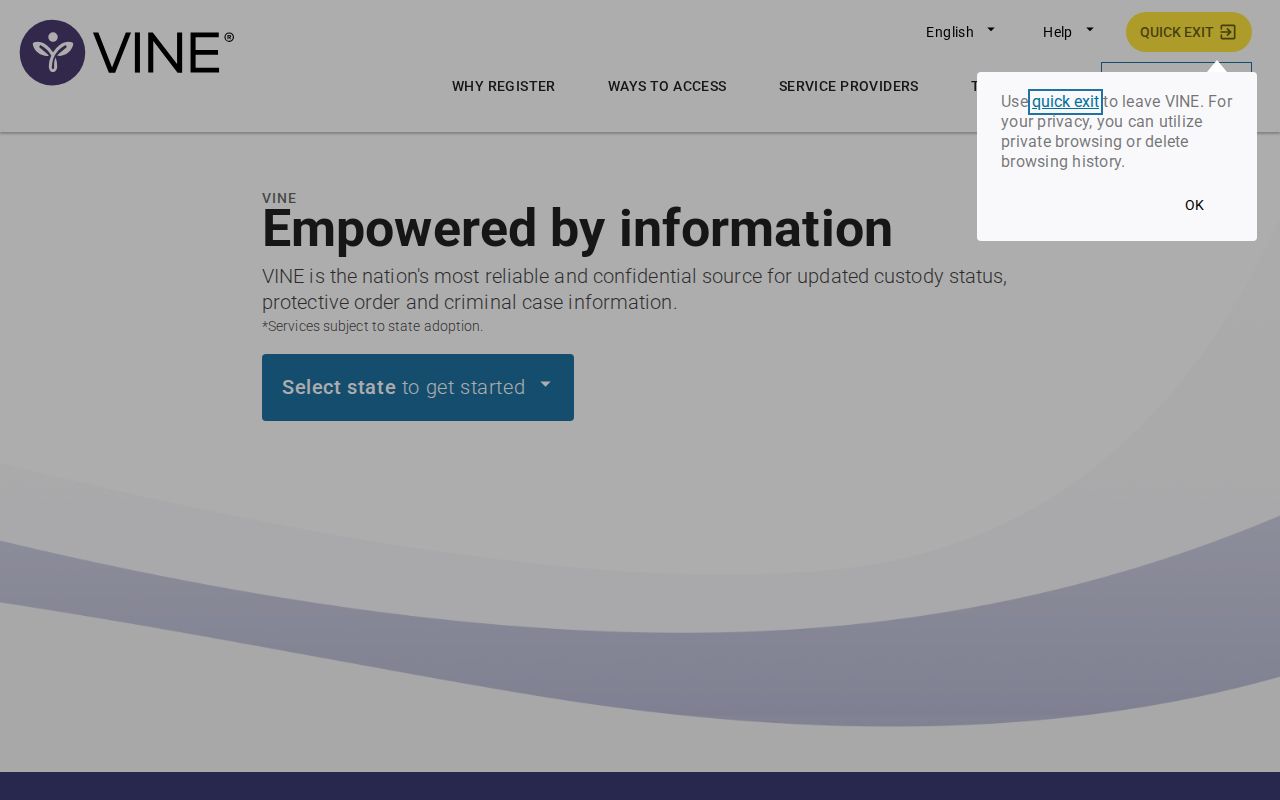
The official VINELink search interface supports Kentucky selection, person matching, status review, and notification registration.
Morgan County VINE Result Fields
The fields available can vary with the participating agency feed. Kentucky's official description states that an in-custody result can provide the facility location, address, and telephone number. When the named person is not in custody, it can give the date released. Preserve the exact words rather than converting a status into a broader claim.
| Field or event | How to read it |
|---|---|
| Custody status | States what the selected agency reports now, subject to feed timing. |
| Facility or agency | Identifies the custodian whose event is being reported. |
| Jail or DOC identifier | Helps separate people with similar names. |
| Release date | Shows the date reported when the person is no longer in that custody. |
| Transfer event | Shows that one custody ended and another may have begun. |
| Notification options | Lists the methods currently offered for that matched record. |
VINE is an event and status source, not a complete legal history. A court order may explain why a local jail released someone, while the jail's movement record gives the exact time, reason, and destination. For an EKCC release, KOOL and KDOC Daily Releases can add state status, institution, date, and release type.
Read Morgan County VINE Events
“Released” and “transferred” answer different questions. A release event indicates the reporting custodian says its custody ended. It does not by itself prove final discharge from every sentence or establish that no other hold followed. A transfer event is even narrower. It means the first agency's custody ended because another facility or agency may have received the person.
- Release
- The reporting agency ended its custody event; verify destination and legal status.
- Transfer
- The person moved between custodians or facilities and may remain confined.
- Parole
- Conditional release from prison into community supervision authorized through the Kentucky Parole Board.
- Mandatory reentry supervision
- A Kentucky release-to-supervision path that is not the same as final discharge.
- Discharge
- An end to a sentence or supervision whose exact scope must come from the agency record.
If VINE reports transfer from a county jail, ask that jail for the destination. A transfer to KDOC should lead to KOOL. A transfer to another county should lead to that receiving jail. Do not treat the first facility's disappearance or VINE event as proof that the person entered the community.
Register Morgan County Release Alerts
Notification should be tied to the correctly matched record. Kentucky official sources support phone and email, while the current enhanced service may present text or app options. Choose only methods offered in the live interface. VINE alerts are free, available around the clock, and described by Kentucky as confidential from the offender.
- Open the correct person record and select notification registration.
- Choose an offered phone, email, text, or app method.
- For telephone alerts, enter a direct number and create a four-digit PIN. Avoid a switchboard.
- Complete any email or text confirmation requested by the live interface.
- When an alert arrives, record the event, time, facility, and displayed date, then confirm it with the custodian.
The telephone PIN acknowledges the automated call. Keep it private. Do not place contact data or a PIN in a screenshot, shared note, or records request. If registration is changed or canceled, use the current controls and instructions displayed by VINELink.
Morgan County VINE Alert Timing
Kentucky publishes detailed notification timing. For a participating local-jail release, telephone calls repeat every 30 minutes during a 24-hour period or until the four-digit PIN acknowledges the message. For a state-institution release, notice is attempted 72 hours in advance when possible. These are alert practices, not promises that a public roster refreshes on the same schedule.
Advance notice may not be possible after an immediate court order, application of custody credit, parole processing, or escape. A data feed can also lag. Once an alert arrives, contact the receiving jail or KDOC if the exact physical event or legal status matters. Write down the agency name and exact event language before calling.
Local and state timing should not be blended. A Morgan arrest housed at an out-of-county receiving jail follows that jail's event feed. An EKCC prisoner follows the KDOC state-institution path. The same VINELink interface can display both, but the underlying custodians remain distinct.
Corroborate Morgan County VINE Alerts
Kentucky provides two useful state release artifacts beyond a VINE event. KOOL shows current prison or community-supervision location and identifiers. The KDOC Daily Releases archive offers date-indexed reports with the recorded institution and release type. For an EKCC case, all three sources can be compared.
| Source | Question answered |
|---|---|
| VINE | What custody event or current status did the participating agency report? |
| KOOL | Does KDOC show prison custody, a community district, or another state status? |
| KDOC Daily Releases | Did a dated state report record a release type from the institution? |
| Custodian record | What were the actual movement time, reason, and destination? |
| Morgan court file | What order or disposition supplied legal authority in the county case? |
A Daily Releases entry may show parole or mandatory reentry supervision rather than unconditional discharge. KOOL may show a supervision district after physical release. If the sources do not align, request the KDOC movement, release, or discharge record using the DOC or PID number instead of choosing the result that appears newest.
Morgan County VINE Limits
VINE depends on data from participating agencies. A delay, incomplete identifier, wrong state, spelling variation, or same-name match can produce an uncertain result. The service does not establish the final court outcome, and VINEcourts is no longer available. Use the Morgan clerk for bond, dismissal, judgment, sentencing, probation, and revocation orders.
The service also does not cover BOP custody or ICE custody. The BOP locator covers federal prisoners from 1982 onward and can display a released status and past date. ICE uses a separate locator and retains released-person search visibility for a limited period. Silence in VINE cannot rule out either system.
- Confirm the selected state and agency.
- Match more than the person's name.
- Read transfer and release as separate events.
- Record the lookup and event times.
- Verify consequential details with the originating custodian.
A safety concern should never depend solely on an automated alert. Follow the official VINE guidance, use emergency services when appropriate, and maintain any safety plan through the relevant public agency or qualified service provider.
Correct Morgan County VINE Conflicts
When VINE appears wrong, first compare identity, agency, booking or DOC number, and event time. The source agency's feed may contain the underlying issue. Contact that receiving jail or KDOC records office and ask for its correction procedure. A VINE display that accurately repeats an agency record usually must be corrected at the source.
Create a short timeline with the booking, court action, transfer, prison release, supervision start, and final discharge dates that apply. Label each source. Two dates can both be right when one is a court order and the other is physical release. A VINE transfer can also precede a later release from the receiving custodian.
Request the existing movement record rather than asking staff to infer what happened. For a court error, contact the Morgan Circuit Court Clerk. For a KOOL or KDOC issue, use the state offender-information or open-records route with the correct identifier. This preserves the scope of each system and avoids turning a disputed alert into an unsupported conclusion.